Pearson Edexcel · GCSE · Psychology
Course version: 1PS0 · Version from Sept 2017
Memory - 2.2 Studies: *2.2.2 Peterson and Peterson (1959) Short-term…
Full specification wording
Topic 2: Memory - 2.2 Studies: *2.2.2 Peterson and Peterson (1959) Short-term Retention of Individual Verbal Items
Peterson and Peterson (1959) investigated the duration of short-term memory by preventing rehearsal.
Checked against the Pearson Edexcel 1PS0 specification (opens in a new tab) on .
- Point 2 of 2
- 4 key terms
Study notes
From the checked teaching notes for this specification point.
The idea
Peterson and Peterson (1959) investigated the duration of short-term memory by preventing rehearsal. Participants were presented auditorily with trigrams (meaningless three-consonant syllables) and asked to count backwards in threes from a random number. This interference task prevented rehearsal. After intervals of 3, 6, 9, 12, 15, or 18 seconds, a red light signalled them to recall the trigram. Recall accuracy dropped rapidly, from high accuracy at 3 seconds to below 10% after 18 seconds, establishing STM duration as approximately 18 seconds. A strength is the highly controlled laboratory procedure, allowing cause and effect to be established. A weakness is the artificial task, meaning it lacks ecological validity.
What earns the marks
- Identify the aim: to test the duration of short-term memory when rehearsal is prevented.
- Describe the procedure: participants auditorily received consonant trigrams and recalled them after varying intervals while counting backwards.
- State the findings: recall accuracy decreased significantly as the time interval increased, dropping below 10% at 18 seconds.
- Explain the conclusion: short-term memory has a limited duration of up to 18 seconds if maintenance rehearsal is prevented.
- Evaluate the study: a strength is high control over extraneous variables; a weakness is the use of artificial stimuli (low ecological validity).
Common mistakes and how to put them right
Thinking the counting task was the information to be remembered.
Put it right: The counting task was an interference task designed solely to prevent participants from rehearsing the trigrams.
Stating the study tested the capacity of short-term memory.
Put it right: The study specifically tested the duration, meaning how long information lasts, not capacity, which is how much it holds.
Claiming the trigrams were presented visually.
Put it right: The consonant trigrams were presented auditorily to the participants.
Exam tips
- Ensure you can distinguish between the independent variable (time interval) and the dependent variable (correctly recalled trigrams).
- Use the specific term interference task when describing why participants were asked to count backwards.
- Be prepared to evaluate the study by discussing its high level of control and its low ecological validity.
Try the lesson
The start of the Topic 2: Memory - 2.2 Studies: *2.2.2 Peterson and Peterson (1959) Short-term Retention of Individual Verbal Items lesson, made from checked teaching notes for this specification point.
Have a go first
What type of information were participants asked to remember in Peterson and Peterson's (1959) study of short-term retention?
Listen
Peterson and Peterson (1959) investigated the duration of short-term memory by preventing rehearsal. Participants were presented auditorily with trigrams (meaningless three-consonant syllables) and asked to count backwards in threes from a random number. This interference task prevented rehearsal. After intervals of 3, 6, 9, 12, 15, or 18 seconds, a red light signalled them to recall the trigram. Recall accuracy dropped rapidly, from high accuracy at 3 seconds to below 10% after 18 seconds, establishing STM duration as approximately 18 seconds. A strength is the highly controlled laboratory procedure, allowing cause and effect to be established. A weakness is the artificial task, meaning it lacks ecological validity. A strong answer earns marks for these points. Identify the aim: to test the duration of short-term memory when rehearsal is prevented. Describe the procedure: participants auditorily received consonant trigrams and recalled them after varying intervals while counting backwards. State the findings: recall accuracy decreased significantly as the time interval increased, dropping below 10% at 18 seconds. Explain the conclusion: short-term memory has a limited duration of up to 18 seconds if maintenance rehearsal is prevented. A common slip: Thinking the counting task was the information to be remembered. Instead, The counting task was an interference task designed solely to prevent participants from rehearsing the trigrams. Exam tip: Ensure you can distinguish between the independent variable (time interval) and the dependent variable (correctly recalled trigrams).
See it
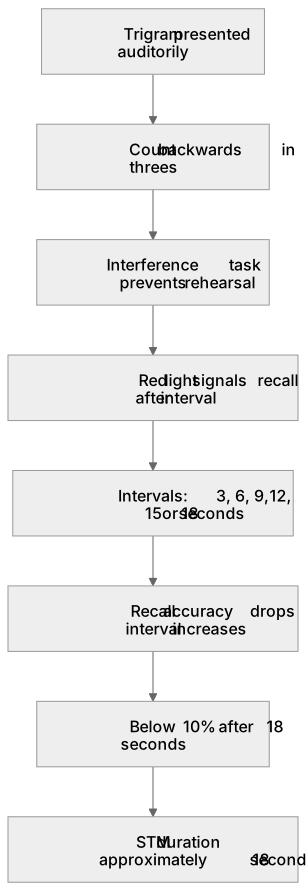
Put it in order
Put these steps in the order they happen.
- 1. Intervals: 3, 6, 9, 12, 15 or 18 seconds
- 2. STM duration approximately 18 seconds
- 3. Recall accuracy drops as interval increases
- 4. Trigram presented auditorily
- 5. Count backwards in threes
- 6. Below 10% after 18 seconds
- 7. Interference task prevents rehearsal
- 8. Red light signals recall after interval
Key words
Say what each word means before you turn the card.
Duration
Try answering aloud or in your head before turning the card.
Interference
Try answering aloud or in your head before turning the card.
Short-term memory
Try answering aloud or in your head before turning the card.
Research evaluation
Try answering aloud or in your head before turning the card.
See every definition
- Duration
- How long information lasts in memory, tested here by recall after intervals of 3 to 18 seconds.
- Interference
- An interference task, counting backwards in threes from a random number, was used to prevent rehearsal of the trigrams.
- Short-term memory
- Memory whose duration was established as approximately 18 seconds when rehearsal is prevented.
- Research evaluation
- A strength is the highly controlled laboratory procedure, allowing cause and effect to be established; a weakness is the artificial task, meaning it lacks ecological validity.
Label the diagram
Some boxes have lost their names. Pick the right name for each number.
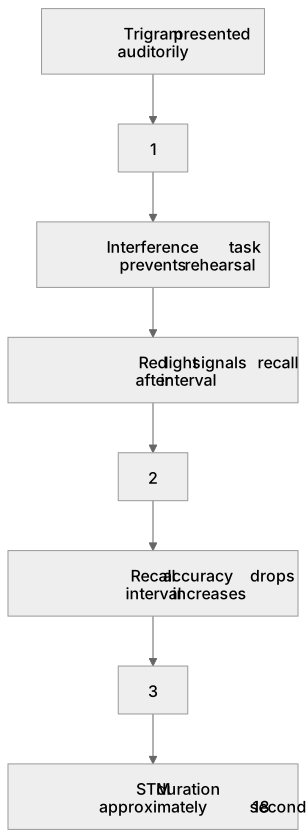
1Box 1
2Box 2
3Box 3
There is more to this lesson
The full lesson goes on to check your understanding and help you earn the marks. Create a free account to carry on, with your progress saved.
A week of Premium from your first lesson · Then the free plan continues · No card, no charge
Test your understanding of Topic 2: Memory - 2.2 Studies: *2.2.2 Peterson and Peterson (1959) Short-term Retention of Individual Verbal Items
Active recall beats re-reading. Take an instant quiz now to test what you’ve learned and lock it into long-term memory.
A week of Premium from your first lesson · Then the free plan continues · No card, no charge